



If you’ve been looking at house plans for more than about ten minutes, you’ve probably noticed how quickly square footage becomes the headline.
Bigger numbers feel reassuring. More space feels like a safety net—especially when you’re planning for kids, work-from-home life, hosting family, or just wanting room to breathe.
But here’s what I’ve seen again and again in real homes:
Square footage doesn’t reduce daily friction. Layout does.
And the families who feel calm and supported in their homes? They almost always chose a thoughtful layout over simply choosing a larger house.
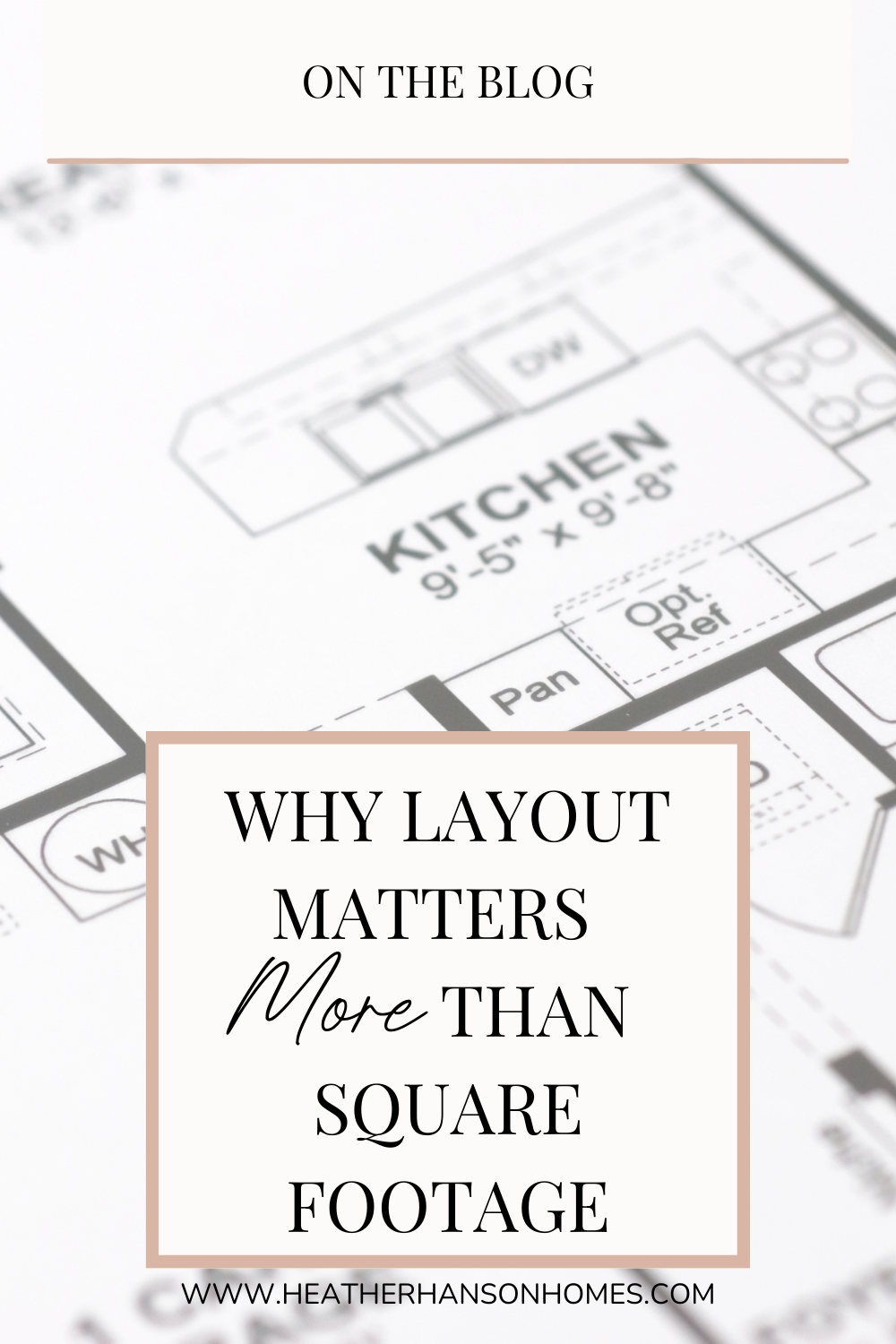
Let’s talk about why floor plan layout matters more than square footage.
Square Footage Is a Number. Layout Is a System.
Square footage tells you how much space you have.
Layout determines how that space actually works.
A home can be 3,200 square feet and still feel tight, loud, and mentally draining if:
- Daily paths cross awkwardly
- Storage isn’t where it’s needed
- Bedrooms don’t support real sleep schedules
- The kitchen works against family routines
On the flip side, I’ve worked with many families in smaller homes who feel genuinely supported because the layout was well-considered.
The difference is not style or budget. It’s how intentionally the spaces relate to one another.
The Real Cost of a Poor Layout Is Daily Mental Load
Most layout issues don’t show up on move-in day. They show up on a Tuesday evening.
- Where do backpacks land?
- Where does laundry actually get folded?
- Can someone work while another person cooks?
- Is bedtime peaceful—or chaotic?
When a layout doesn’t support these moments, you compensate. You manage around the house instead of the house supporting you.
That constant micro-adjusting is exhausting over time.
A good layout quietly removes that burden.
Why Bigger Isn’t Always Better for Families
More square footage often brings:
- Longer walking distances
- More rooms to maintain
- Higher building and operating costs
- More places for clutter to accumulate
Without strong layout logic, bigger homes can actually increase mental load instead of reducing it.
A smaller or mid-sized home with clear zoning, logical adjacencies, and purposeful shared spaces often feels calmer and easier to live in long-term. This is why floor plan layout matters more than square footage.
The Layout Priorities That Matter Most
When I help families evaluate plans, we focus less on size and more on questions like:
- Does this layout support our daily routines?
- Are private and shared spaces appropriately separated?
- Does the kitchen work as a true command center?
- Is there friction built into everyday paths?
These are the decisions that hold up for years—not just at closing.
If you’re early in the process and feeling overwhelmed, this is exactly where clarity helps most.
The Family Floor Plan Priorities Guide walks you through what actually matters before you fall in love with square footage alone. It helps you set calm, low-regret priorities—without adding more noise.
If You’re Not Sure What Stage You’re In
Many families aren’t sure whether they should be:
- Still clarifying priorities
- Comparing plans
- Or preparing to commit
That’s normal.
If you want gentle guidance on what to focus on next, the Free Home Planning Quiz can help you understand what stage you’re in—and what you may be overlooking—without pressure or urgency.
A Calm Closing Thought
Square footage is easy to measure.
A supportive home is something you feel over time.
When your layout works, life feels steadier.
And that feeling is worth far more than an extra few hundred square feet.